


Next: How big is Hilbert
Up: No Title
Previous: Introduction
The following statements were discussed in more or less detail in
class. If you think you understand a particular statement, then you
should attempt to explain it to one another. If you can explain it
one sitting in such a way that everyone is convinced of its validity,
do not hand in a written version of your explanation. If on the other
hand, you cannot explain it one sitting-notes are allowed-then you
should put together a convincing argument for the statement and hand
in a written version.
- 1.
- (a)
- The distance function d2 is well-defined on
 .
.
- (b)
- The distance function d2 defines a metric on the set
.
- 2.
- (a)
- If [f],
![$[g] \in {\cal L}^{2}(E)$](img7.gif) ,
then
,
then
![$[fg] \in {\cal
L}^{1}(E)$](img8.gif) .
.
- (b)
- If
 ,
then
,
then
 and
and
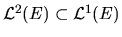 .
.
- (c)
- If
 ,
then it is not the case that
.
,
then it is not the case that
.
- (d)
- There exist
 that are not in
.
that are not in
.
- 3.
- We define addition and scalar multiplication of equivalence
classes by
| [f] + [g] |
= |
[f + g] |
|
| a[f] |
= |
[af] |
|
- (a)
- These operations are well-defined on
.
- (b)
- With these operations,
is a real vector
space.
- 4.
- We defined an inner product on
by
![$< [f],[g] > = \int_{E}fgdm$](img14.gif) ,
which we used to define the norm of an
equivalence class,
,
which we used to define the norm of an
equivalence class,
![$\parallel [f] \parallel = \sqrt{<[f],[f]>}$](img15.gif) .
.
- (a)
- The inner product and norm are well-defined on
.
- (b)
- The inner product satisfies the usual definition of an inner
product.
- (c)
- The Cauchy-Schwarz inequality holds:
- (d)
- The triangle inequality holds:
- 5.
- Now we come to the important result:
is
complete.
- (a)
- i.
- If
,
then every sequence that is Cauchy in
is also Cauchy in
 .
.
- ii.
- If E is bounded, then
is complete.
- (b)
- If
then we wrote E as the infinite union of
the sets
![$E_{k} =E \cap [-k,k]$](img19.gif) .
.
- i.
- Use a Cantor diagonal process to show that every Cauchy sequence
has a convergent subsequence.
- ii.
- Show that
is complete.
A complete inner product space is called a Hilbert space after
the German mathematician David Hilbert (1862-1943). He is
acknowledged to be one of the greatest mathematicians of the first
half of this century. Part of his legacy to the mathematical
community is his list of 23 problems that he posed at the
International Congress of Mathematicians in 1900, which have since
come to be known as ``the Hilbert problems''. These problems have had
a profound impact on mathematics in this century. At the end of the
millenium-get used to it, its coming-there will most certainly be an
attempt by a committee to produce a list of problems for the coming
century.
Next: How big is Hilbert
Up: No Title
Previous: Introduction
2000-03-08

![\begin{displaymath}\mid <[f],[g]> \mid \leq \parallel f \parallel \parallel g \parallel
\end{displaymath}](img16.gif)
![\begin{displaymath}\parallel [f] + [g] \parallel \leq \parallel [f] \parallel + \parallel
[g] \parallel
\end{displaymath}](img17.gif)