


 ,
since this allowed us to employ the techniques
that were developed in Linear Algebra so simplify our search for a
basis. Naturally, our goal was to produce an orthornormal basis.
In order to make the problem tractable, we assumed that E = [0,1].
(Out of laziness I have dropped the notation [f] in this section and
will simply write f.)
,
since this allowed us to employ the techniques
that were developed in Linear Algebra so simplify our search for a
basis. Naturally, our goal was to produce an orthornormal basis.
In order to make the problem tractable, we assumed that E = [0,1].
(Out of laziness I have dropped the notation [f] in this section and
will simply write f.)
Since we believed that
 was a ``big'' vector space, we
initially tried to produce an infinite linearly independent set. As
our first guess, we chose the functions
was a ``big'' vector space, we
initially tried to produce an infinite linearly independent set. As
our first guess, we chose the functions
![$f_{i} = \chi_{[0,2^{-i}]}$](img20.gif) .
We observed
.
We observed
 is a linearly independent set that
does not span
.
is a linearly independent set that
does not span
.
,
we said we would allow
infinite linear combinations

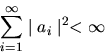
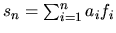 converges if and only
if
converges if and only
if
![$\chi_{[0,1]}, \
\chi_{[0,1/2]}, \ \chi_{[0,1/4]}, \ \chi_{[1/2,3/4]}, \ldots$](img25.gif) is
linearly independent and spans
is
linearly independent and spans
![${\cal L}^{2}([0,1])$](img26.gif) ,
but is not
orthonormal.
,
but is not
orthonormal.
![$f(x) = \chi_{[0,1/2]} -
\chi_{[1/2]}$](img27.gif) ,
the Haar function (which resembles the Rademacher
functions we used last semester), we can generate an orthogonal
spanning set by scaling and shifting f. We used
,
the Haar function (which resembles the Rademacher
functions we used last semester), we can generate an orthogonal
spanning set by scaling and shifting f. We used
 .
These can be normalized to produce an
orthormal basis.
.
These can be normalized to produce an
orthormal basis.
The Haar function is called a mother wavelet and the resulting basis is called a wavelet basis. We need to find the expression for the entire basis in terms of f, which means finding the complete pattern for the scaling and shifting coefficients, and we need to find the normalization factors in order to make the basis orthonormal.
The wavelet basis for
extends by shifting to
produce a basis for
 .
.
 is an orthogonal set of functions in
![${\cal L}^{2}([0,2\pi])$](img31.gif) .
We need to find the normalization factors in order to make the set
orthonormal and we need to show that this set spans
.
This collection of functions is the Fourier basis
for
.
.
We need to find the normalization factors in order to make the set
orthonormal and we need to show that this set spans
.
This collection of functions is the Fourier basis
for
.
How would you adjust this collection of functions
to produce a basis for
![${\cal L}^{2}([a,b])$](img32.gif) ? (It takes a bit more than
saying expand the domain.) This basis does not extend to a basis for
.
? (It takes a bit more than
saying expand the domain.) This basis does not extend to a basis for
.
 are linearly independent in
,
but not in
.
(The second part is a trick question.)
Show that these functions are not orthonormal. Can you produce an
orthonormal set in
,
are linearly independent in
,
but not in
.
(The second part is a trick question.)
Show that these functions are not orthonormal. Can you produce an
orthonormal set in
,
 so
that fi is a polynomial of degree i. Does this set span
?
so
that fi is a polynomial of degree i. Does this set span
?