


 .
First, a function
.
First, a function
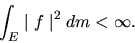
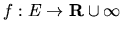 is square integrable if
 is the collection of
all equivalence classes of square integrable functions.
is the collection of
all equivalence classes of square integrable functions.
We defined a metric on
by
![$d^{2}([f],[g]) = \int_{E}
(f - g)^2 dm$](img5.gif) .
Our first task was to show that
is
complete. The first part of this worksheet takes you through this
result and the necessary background material. The second part
addresses the algebraic questions that arise when we give
the structure of an inner product space.
.
Our first task was to show that
is
complete. The first part of this worksheet takes you through this
result and the necessary background material. The second part
addresses the algebraic questions that arise when we give
the structure of an inner product space.