




MATH 392 -- Seminar in Computational Commutative Algebra
Lab 2/Problem Set 5 Solutions
| > | with(Groebner); |
| > | Plist:=[x^2*y + x^2 + 1, x^3 + x*y + 2]; |
![[x^2*y+x^2+1, x^3+x*y+2]](images/Lab2_6.gif)
| > |
| > | B:=Basis(Plist,plex(x,y)); |
![[y^4+11*y^2+10*y+5+6*y^3, 2*x+y^3+4*y^2+2*y+1]](images/Lab2_7.gif)
| > |
1. <LT(I)> = <x,y^4>. The monomial ideal <LT(f_1),LT(f_2)> = <x^2y, x^3> is
contained in this.
| > | ![f := (x^4*y+x^2*y^3)*Plist[1]+y^2*Plist[2]; 1](images/Lab2_8.gif) |

2.
| > |  |

3. x has been eliminated from the first equation, so we can solve that,
substitute back for y in the second, and solve for x.
4.
| > | yroots:=[fsolve(B[1]=0,y,complex)]; |
![[-3.618033989, -1.381966011, -.5000000000-.8660254038*I, -.5000000000+.8660254038*I]](images/Lab2_12.gif)
![[-3.618033989, -1.381966011, -.5000000000-.8660254038*I, -.5000000000+.8660254038*I]](images/Lab2_13.gif)
| > | for i to nops(yroots) do
Bs:=subs(y=yroots[i],B); solve(Bs[2],x); end do; |
![[0., 2*x-1.236067958]](images/Lab2_14.gif)

![[0.1e-7, 2*x+3.236067978]](images/Lab2_16.gif)
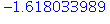
![[0.+0.1402961154e-9*I, 2*x+(-1.000000000+1.732050807*I)]](images/Lab2_18.gif)

![[0.-0.1402961154e-9*I, 2*x+(-1.000000000-1.732050807*I)]](images/Lab2_20.gif)

5. Same idea, but y is eliminated from the first equation:
| > | Basis(Plist,plex(y,x)); |
![[x^4-x^2+2*x-1, 2*x^3+x^2+y-2*x+4]](images/Lab2_22.gif)
6. The grevlex Groebner basis does not have the same elimination
property (also contains 3 polynomials)
| > | Bgrev:=Basis(Plist,tdeg(x,y)); |
![[-3-y^2-5*y+4*x+2*x*y, x^2-3-y^2-4*y+2*x, 2*x+y^3+4*y^2+2*y+1]](images/Lab2_23.gif)
![[-3-y^2-5*y+4*x+2*x*y, x^2-3-y^2-4*y+2*x, 2*x+y^3+4*y^2+2*y+1]](images/Lab2_24.gif)
| > | for i to 3 do LeadingTerm(Bgrev[i],tdeg(x,y)); end do; |


| > |
Book problems:
2.
| > | ![PL2 := [x*z-y, x*y+2*z^2, y-z]; 1](images/Lab2_28.gif) |
![[x*z-y, x*y+2*z^2, y-z]](images/Lab2_29.gif)
| > |  |
![[y-z, 2*z^2+z, x*z-z]](images/Lab2_31.gif)
| > |  |

remainder is not zero, so the given f is not in the ideal.
3.
| > | ![PL3 := [x^2+y^2+z^2-1, x^2+y^2+z^2-2*x, 2*x-3*y-z]; 1](images/Lab2_34.gif) |
![[x^2+y^2+z^2-1, x^2+y^2+z^2-2*x, 2*x-3*y-z]](images/Lab2_35.gif)
| > |  |
![[40*z^2-8*z-23, 3*y+z-1, 2*x-1]](images/Lab2_37.gif)
| > | ![zroots := fsolve(B3[1], z, complex); 1](images/Lab2_38.gif) |

| > | ![B3s := subs(z = zroots[1], B3); 1](images/Lab2_40.gif) |
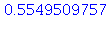
![[0., 3*y-1.664852927, 2*x-1]](images/Lab2_41.gif)
| > | ![solve(B3s[2], y); 1; solve(B3s[3], x); 1](images/Lab2_42.gif) |

| > |
| > | ![B3s := subs(z = zroots[2], B3); 1](images/Lab2_45.gif) |
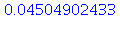
![[-0.1e-7, 3*y-.1351470730, 2*x-1]](images/Lab2_46.gif)
| > | ![solve(B3s[2], y); 1; solve(B3s[3], x); 1](images/Lab2_47.gif) |

| > |
| > |
8.
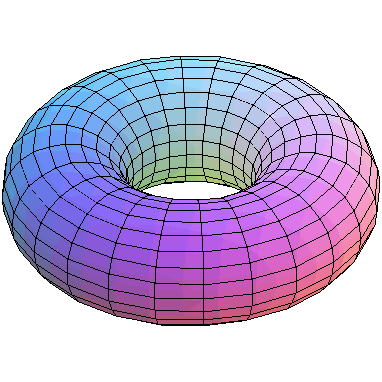
| > | plot3d([(2+cos(t))*cos(u),(2+cos(t))*sin(u),sin(t)],t=0..2*Pi,u=0..2*Pi); |
| > | Id:=[x-(2+ct)*cu,y-(2+ct)*su,z-st,ct^2+st^2-1,cu^2+su^2-1]; |
![[x-(2+ct)*cu, y-(2+ct)*su, z-st, ct^2+st^2-1, cu^2+su^2-1]](images/Lab2_51.gif)
| > | B8:=Basis(Id,plex(ct,st,cu,su,x,y,z)); |






| > | ![B8[1]; 1](images/Lab2_58.gif) |

| > |  |

9. The torus knot:
| > | ![PLK := [x-(2+a^2-b^2)*(4*a^3-3*a), y-(2+a^2-b^2)*(4*b*a^2-b), z-2*a*b, a^2+b^2-1]; 1](images/Lab2_62.gif) ![PLK := [x-(2+a^2-b^2)*(4*a^3-3*a), y-(2+a^2-b^2)*(4*b*a^2-b), z-2*a*b, a^2+b^2-1]; 1](images/Lab2_63.gif) |
![[x-(2+a^2-b^2)*(4*a^3-3*a), y-(2+a^2-b^2)*(4*b*a^2-b), z-2*a*b, a^2+b^2-1]](images/Lab2_64.gif)
![[x-(2+a^2-b^2)*(4*a^3-3*a), y-(2+a^2-b^2)*(4*b*a^2-b), z-2*a*b, a^2+b^2-1]](images/Lab2_65.gif)
| > |  |















| > | ![NormalForm(B8[1], B9, plex(a, b, x, y, z)); 1](images/Lab2_82.gif) |

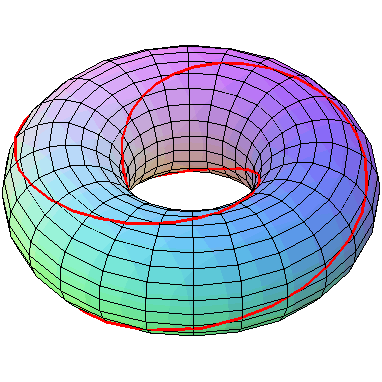
This says the curve K lies on the torus T. Here is a plot showing that:
| > | ![TP := plot3d([(2+cos(t))*cos(u), (2+cos(t))*sin(u), sin(t)], t = 0 .. 2*Pi, u = 0 .. 2*Pi); -1](images/Lab2_84.gif) ![TP := plot3d([(2+cos(t))*cos(u), (2+cos(t))*sin(u), sin(t)], t = 0 .. 2*Pi, u = 0 .. 2*Pi); -1](images/Lab2_85.gif) |
| > | ![KP := spacecurve([(2+cos(2*s))*cos(3*s), (2+cos(2*s))*sin(3*s), sin(2*s)], s = 0 .. 2*Pi, numpoints = 100, color = red, thickness = 2); -1](images/Lab2_86.gif) ![KP := spacecurve([(2+cos(2*s))*cos(3*s), (2+cos(2*s))*sin(3*s), sin(2*s)], s = 0 .. 2*Pi, numpoints = 100, color = red, thickness = 2); -1](images/Lab2_87.gif) |
| > |  |
| > |  |
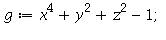
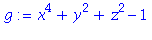
10. We want to maximize the (squared) distance f from the
point (1,1,1), at the poinst on the surface V(g) using Lagrange Multipliers
| > |  |

| > |  |
| > | ![PL10 := [(diff(f, x))-lambda*(diff(g, x)), (diff(f, y))-lambda*(diff(g, y)), (diff(f, z))-lambda*(diff(g, z)), g]; 1](images/Lab2_95.gif) ![PL10 := [(diff(f, x))-lambda*(diff(g, x)), (diff(f, y))-lambda*(diff(g, y)), (diff(f, z))-lambda*(diff(g, z)), g]; 1](images/Lab2_96.gif) |
![[2*x-2-4*lambda*x^3, 2*y-2-2*lambda*y, 2*z-2-2*lambda*z, x^4+y^2+z^2-1]](images/Lab2_97.gif)
| > |  |







| > | ![zrts := fsolve(B10[1], z, complex); 1](images/Lab2_106.gif) |






| > | ![B10s := subs(z = zrts[3], B10); 1](images/Lab2_113.gif) |
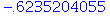
![[0.5e-8, y+.6235204055, 4*x+2.74704305, 8*lambda-20.83037400]](images/Lab2_114.gif)
| > | ![zrts[3]; 1; solve(B10s[2], y); 1; solve(B10s[3], x); 1](images/Lab2_115.gif) |
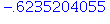
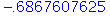
| > |
| > | ![B10s := subs(z = zrts[6], B10); 1](images/Lab2_119.gif) |
![[0.2e-8, y-.6348187101, 4*x-2.65470491, 8*lambda+4.602023047]](images/Lab2_120.gif)
| > | ![zrts[6]; 1; solve(B10s[2], y); 1; solve(B10s[3], x); 1](images/Lab2_121.gif) |


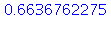
Clearly the point with all positive coordinates is closer to (1,1,1) than the point
with all negative coordinates.
| > |