Next: About this document ...
startsection section10mm-.5 Discussion 1 European Union Expansion and the Banzhaf Index of Power
In December 1997 the European Union agreed to a program of expansion
that would increase the union from the current total of 15 members to
26 members in two waves of 6 and 5 countries. One of the central
issues that must be resolved is how to distribute votes, or weights,
to the entering countries and how to set the quota, which is the
number of votes necessary for the passage of legislation. In this
discussion we'll calculate the Banzhaf index of power for the EU
before and after expansion with different values for the quota.
Throughout this discussion we will be using the Banzhaf index
calculator available on the WWW from Temple University at:
http://www.math.temple.edu/~cow/bpi.html.
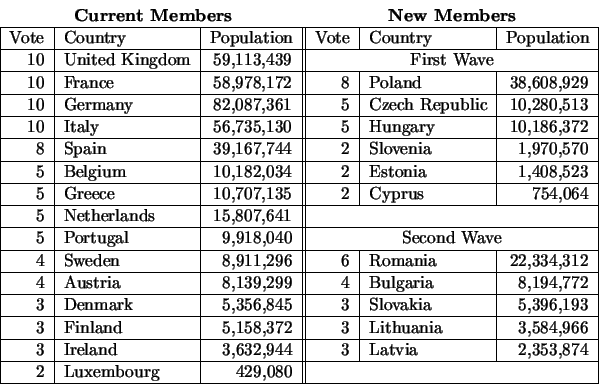
European Union Data
The following population data for the EU was obtained from World
Factbook 1999 maintained by the
CIA at http://www.cia.gov/cia/publications/factbook/index.html.
Exercises
To complete the following exercises you will need to go to the Temple University web site:
http://www.math.temple.edu/~cow/bpi.html .
- 1.
- Compute the Banzhaf power index percentage for the current membership and
distribution of votes for the European Union for the current quota of 62.
Note: When using the on-line Banzhaf Power Index Calculator, the
quota goes in a separate box from the weights and the weights should
be entered in a list of numbers separated by commas. Also, the
software reports the number of coalitions for which a voter is
critical in the ``Banzhaf power index list'' and what we call the
power index as the ``power of each voter as a percentage''.
- 2.
- Now let's consider what happens when the first wave of
countries is added to the EU.
- (a)
- Compute the Banzhaf power index percentage for the original 15
countries of the EU together with the 6 countries of the first wave
using 80 as the quota. (The quota 80 is in the same ratio to the new
vote total, 111, as the current total, 62, is to the current vote
total, 87.)
- (b)
- How did the power index percentages change for the existing
members from the current scheme to the new scheme? Which countries
percentages were most effected?
- 3.
- Now let's consider the effect of changing the quota in our
calculations for the EU with the first wave included. For each part,
do several calculations.
- (a)
- What is the effect on the power index percentages of raising the
quota above 80?
- (b)
- What is the effect on the power index percentages of lowering the
quota below 80?
- (c)
- Are there countries that might prefer a higher or lower quota?
Why?
- 4.
- A different way to think about the relationship between the
quota and voting power is to think about the power of blocs of
countries based on size. For the purposes of this question, we will
consider the United Kingdom, France, Germany, Italy, Spain and Poland
to be large countries; Belgium, Greece, the Netherlands, Portugal,
Sweden, the Czech Republic, and Hungary to be medium-sized countries;
and Denmark, Finland, Ireland, Luxembourg, Slovenia, Estonia and
Cyprus to be small countries. In the current EU we will consider
Austria to be small, since it's in the bottom third in population, and
in the expanded EU we will consider it to be medium-sized to maintain
the balance between small and medium-sized countries.
- (a)
- Compute the number of votes for the three blocs-large
countries, medium-sized countries, and small countries-for the
current EU. Using these as weights, compute the Banzhaf power index
percentages for these blocs with a quota of 62.
- (b)
- Compute the Banzhaf power index percentages for the EU with
the first wave included, with a quota of 80, and with the countries again
divided into three blocs. How do these bloc percentages compare to
the percentages in part (a)? Do you see a potential problem?
- (c)
- By changing the quota above or below 80, try to make the bloc
percentages for the EU including the first wave of countries equal (or
close to equal) to the bloc percentages for the original EU.
- (d)
- Based upon your calculations, how would you propose to set the
quota for the expanded EU assuming that each country has the number
of votes indicated above? Justify your answer.
Next: About this document ...
2000-03-03